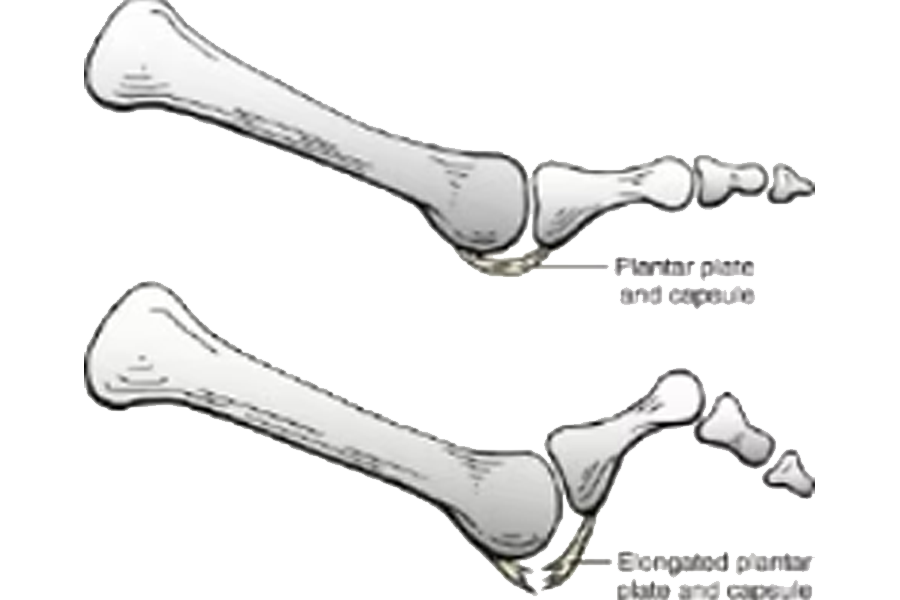
The plantar plate is a ligamentous structure on the bottom of the foot connecting the foot to the toe. It is comprised of multiple soft tissue structures including capsular, tendinous, and plantar fascia contributions, which serve to stabilize the toe. Not only does the plantar plate help pull the toe down toward the floor, it also serves to stabilize side-to-side deviation and maintain the alignment of the toe.
When the plantar plate tears, the toe may begin to deviate to the side, or start to raise off the floor. Patients often complain of pain at the base of the toe with activity related discomfort. The toe may appear to be out of alignment with the other toes.
Conservative Treatment
Prior to operative intervention, there are multiple conservative therapy options that may be beneficial in treating plantar plate tears. Perhaps the first intervention should be the selection of an appropriate shoe. A cushioned athletic shoe with a wide toe-box may relieve pressure on the bottom of the foot and may provide room for the toes so they are not constricted. Some patients find that taping the toe down or taping the toe to the neighboring toes may help to maintain alignment. Anti-inflammatory medications may afford pain relief and help decrease swelling in the toe. There are multiple pre-constructed toe splints and pads that may help maintain alignment and cushion bony prominences. A silicone toe sleeve or a toe spacer can help avoid painful callous formation especially in patients with concomitant hammertoes or mallet toes.
Surgical Intervention
If conservative treatment options have not provided relief, then an operation may be beneficial. Surgeons have historically transferred tendons from the bottom of the toe to the top of the toe to pull the toe back down to the floor. This 'flexor to extensor tendon transfer' is still considered a very good operation and continues to be used quite commonly. An alternative to the flexor-extensor tendon transfer is to directly repair the plantar plate. Plantar plate repair has evolved significantly over the past decade. Surgeons now have a more complete understanding of plantar plate anatomy and better surgical tools to access and repair these tears. Sometimes the plantar plate tear cannot be repaired because of inadequate quality tissue, and a flexor-extensor tendon transfer may be best. A standard plantar plate repair is performed with sutures to re-approximate or advance the plantar plate back to the base of the toe. A portion of the operation involves shortening the metatarsal a few millimeters with a 'Weil Osteotomy'. Shortening the metatarsal allows the surgeon to gain access to the plantar plate and also decreases tension on the repair and pressure on the forefoot post-operatively. The goal of surgery is to relieve pain on the bottom of the forefoot and to re-align the toe. Often times, multiple toes are done at the same surgical setting. Additional procedures may be done in addition to the plantar plate repair to help accomplish realignment including: Weil osteotomy, flexor-extensor tendon transfer, extensor tendon release, capsulotomy, neuroma excision, and hammer or mallet toe correction. If a simultaneous hammertoe or mallet toe correction is performed pins may be used to hold the toe in the corrected position and these pins can be easily removed in the office around 4-6 weeks.
Cases
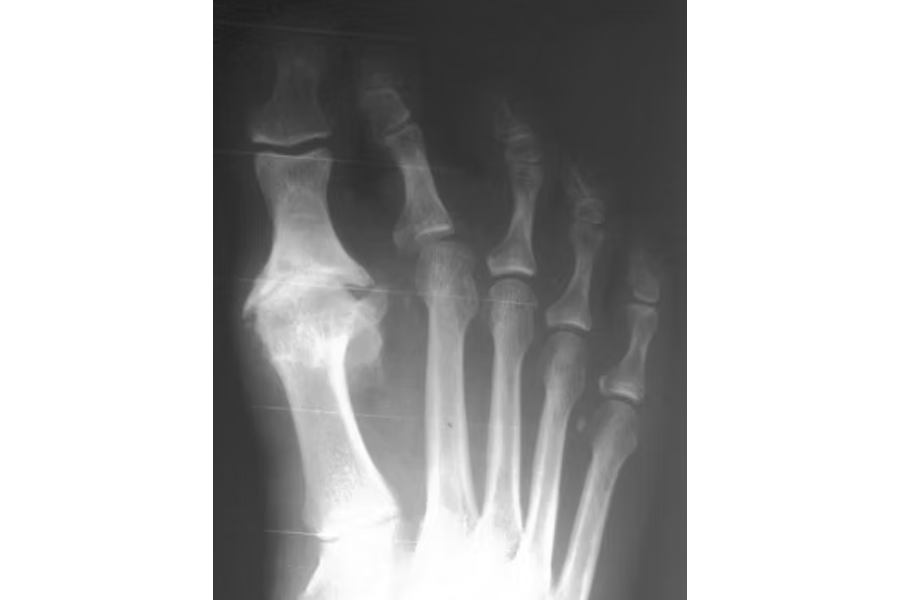
A radiograph of a patient with a plantar plate tear and deviation of the second toe.
Integrity Orthopedics and Sports Medicine
Offering a focused portfolio of advanced orthopedic services and a convenient walk-in clinic designed to help you get back to living—and moving—comfortably.